**PCI under the Viksit Bharat Shiksha Adhishthan Framework and the National Pharmacy Commission Debate: Continuity, Reform, and the Future of Pharmacy Education:
A New Regulatory Architecture for Pharmacy in India
Dr. N. Sriram
Professor of Pharmacy | Academic Researcher, Speaker & Medical Writer, Hyderabad
drnsriram@gmail.com
India’s regulatory reforms in education and healthcare are entering a decisive phase. The Viksit Bharat Shiksha Adhishthan (VBSA) Bill, 2025 and the ongoing discourse around the National Pharmacy Commission (NPC) Bill represent two distinct, yet interconnected, efforts to modernize governance. While the former reshapes the higher-education ecosystem, the latter seeks to redefine professional regulation in pharmacy. Together, they signal a strategic rethinking of how India prepares its healthcare workforce for the future.
Contrary to initial apprehensions, the VBSA Bill does not dilute the authority of the Pharmacy Council of India (PCI). Instead, it introduces a sophisticated regulatory evolution, repositioning PCI as a high-level Professional Standard Setting Body (PSSB) within the broader Viksit Bharat framework. At the same time, the NPC Bill—still at the proposal stage—represents a forward-looking but separate reform pathway aimed at long-term transformation of pharmacy education and practice.
PCI’s transformation under the VBSA Bill: from regulator to professional standard-setter
The VBSA Bill explicitly retains PCI’s independent statutory status under the Pharmacy Act, 1948, while redefining its functional role. Rather than operating as a day-to-day administrative regulator of institutions, PCI is envisaged as a guardian of academic, clinical, and professional standards for pharmacy education nationwide.
This transition elevates PCI’s authority. Freed from routine institutional approvals, the Council can focus more sharply on curriculum frameworks, competency benchmarks, clinical training standards, and professional ethics. Such an approach aligns with global best practices, where profession-specific bodies concentrate on standards and outcomes rather than administrative micromanagement.
Collaborative governance and the “special invitee” mechanism
A defining feature of the VBSA Bill is its collaborative governance architecture. Under Clause 8, the apex Viksit Bharat Shiksha Adhishthan Commission—and its three functional Councils (Regulatory, Accreditation, and Standards)—may invite PCI nominees as “special invitees” whenever decisions pertain to the exclusive domain of pharmacy.
This provision ensures that pharmacy expertise is embedded at the highest levels of national education policy-making. PCI is no longer an isolated regulator but a strategic partner influencing interdisciplinary education, research integration, and national academic roadmaps, without compromising statutory autonomy.
Ending the dual-regulatory burden: a major relief for pharmacy institutions
One of the most consequential administrative outcomes of the VBSA Bill is the proposed repeal of the AICTE Act, 1987. For decades, pharmacy institutions have faced a dual-regulatory burden, navigating overlapping and sometimes conflicting requirements from PCI and AICTE.
By dissolving AICTE and introducing a “light but tight” common higher-education regulator, the VBSA Bill establishes a single-window institutional governance system. Administrative, financial, and infrastructural oversight shifts to the VBSA framework, while professional standards remain firmly with PCI. This long-awaited separation of roles is expected to reduce compliance fatigue and improve institutional efficiency.
A hybrid regulatory reality within universities
The Bill also formalizes a hybrid regulatory model. While VBSA governs the overall administration, finances, and transparency of multidisciplinary universities, professional programmes regulated by PCI are explicitly exempted from the Bill’s primary regulatory ambit.
This ensures that pharmacy departments within large universities continue to meet the rigorous academic, clinical, and licensing requirements of the Pharmacy Act, 1948, even as the rest of the campus transitions to the new national framework. The result is continuity in professional standards alongside modernization of institutional governance.
Transparency, accountability, and voluntary alignment
Another forward-looking element of the VBSA Bill is its emphasis on public self-disclosure. Higher-education institutions will be expected to disclose finances, audits, infrastructure, faculty strength, and educational outcomes on a centralized public platform.
While professional programmes like pharmacy are exempt from direct regulation, voluntary alignment with these transparency benchmarks can strengthen public trust in pharmacy education and reinforce the profession’s accountability to society.
Cross-disciplinary integration and Bharatiya knowledge systems
The VBSA Bill mandates inclusion of eminent experts from diverse professions—including medicine and law—within its governance structures. This creates opportunities for pharmacy leaders to engage in cross-disciplinary dialogue, fostering integration of health sciences education in line with NEP 2020.
Additionally, the Bill promotes incorporation of Bharatiya knowledge systems and regional languages into curricula. As a Professional Standard Setting Body, PCI is expected to coordinate with the national Standards Council to contextualize pharmacy education—blending modern clinical science with indigenous knowledge and linguistic accessibility.
The National Pharmacy Commission Bill: a parallel but future reform
Running parallel to the VBSA framework is the National Pharmacy Commission (NPC) Bill, currently awaiting approval from the Ministry of Health and Family Welfare. Unlike VBSA, which focuses on institutional governance, the NPC Bill seeks to transform the pharmacy profession itself.
Proponents argue that the existing Pharmacy Act, 1948—though historically significant—may not fully address contemporary challenges such as uneven educational standards, outdated curricula, and limited professional mobility. The NPC Bill proposes a centralized commission with independent boards for education, ethics, registration, assessment, and continuing professional development.
Key proposed features include a National Pharmacy Register, competency-based education, digital transformation, and alignment with global best practices. However, it is critical to note that the NPC Bill has not yet been enacted, and PCI remains the statutory authority at present.
VBSA and NPC: complementary, not contradictory
The VBSA Bill and NPC proposal should not be viewed as competing reforms. VBSA establishes a stable, modern higher-education ecosystem in which professional bodies like PCI function as standard-setters. The NPC Bill, if enacted in the future, would represent a second-stage professional reform, redefining how pharmacy education and practice are governed.
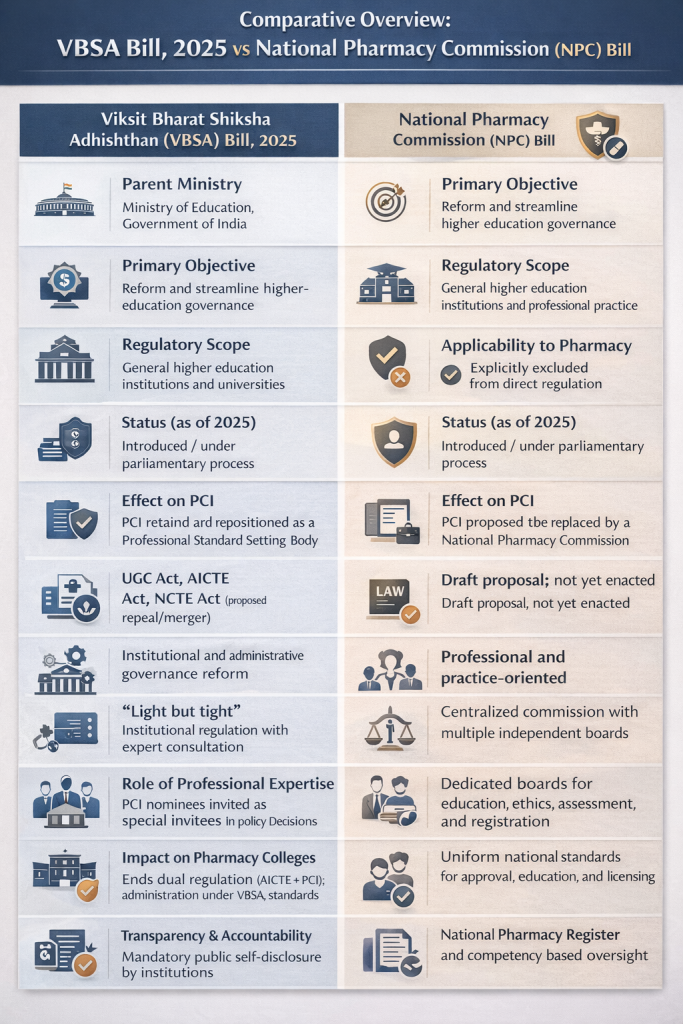
Comparative Overview: VBSA Bill, 2025 vs National Pharmacy Commission (NPC) Bill
| Parameter | Viksit Bharat Shiksha Adhishthan (VBSA) Bill, 2025 | National Pharmacy Commission (NPC) Bill |
|---|---|---|
| Parent Ministry | Ministry of Education, Government of India | Ministry of Health & Family Welfare, Government of India |
| Primary Objective | Reform and streamline higher-education governance | Reform and modernize pharmacy education and professional practice |
| Regulatory Scope | General higher education institutions and universities | Pharmacy education, profession, ethics, and registration |
| Applicability to Pharmacy | No (explicitly excluded from direct regulation) | Yes (central focus of the proposal) |
| Status (as of 2025) | Introduced / under parliamentary process | Draft proposal; not yet enacted |
| Effect on PCI | PCI retained and repositioned as a Professional Standard Setting Body (PSSB) | PCI proposed to be replaced by a National Pharmacy Commission |
| Governing Law Affected | UGC Act, AICTE Act, NCTE Act (proposed repeal/merger) | Pharmacy Act, 1948 (proposed repeal) |
| Nature of Reform | Institutional and administrative governance reform | Professional and practice-oriented regulatory reform |
| Regulatory Model | “Light but tight” institutional regulation with expert consultation | Centralized commission with multiple independent boards |
| Role of Professional Expertise | PCI nominees invited as “special invitees” in policy decisions affecting pharmacy | Dedicated boards for education, ethics, assessment, and registration |
| Impact on Pharmacy Colleges | Ends dual regulation (AICTE + PCI); administration under VBSA, standards under PCI | Uniform national standards for approval, education, and licensing |
| Impact on Pharmacists | Indirect (through university ecosystem and transparency norms) | Direct (education quality, professional mobility, CPD) |
| Transparency & Accountability | Mandatory public self-disclosure by institutions | National Pharmacy Register and competency-based oversight |
| Alignment with NEP 2020 | Strong alignment with multidisciplinary and institutional reforms | Aligns professional education with national healthcare needs |
| Long-term Vision | Create a unified, modern higher-education ecosystem | Build a globally competitive, ethical, and skilled pharmacy workforce |
Conclusion
The regulatory carve-out for pharmacy under the VBSA Bill is not merely about preservation; it is about empowerment. By repositioning PCI as a Professional Standard Setting Body, eliminating dual regulation, and granting a formal voice at the national policy table, the framework elevates pharmacy’s role within the Viksit Bharat vision.
At the same time, the NPC debate underscores the profession’s aspiration for long-term modernization. Whether through strengthened PCI mechanisms or a future commission-based model, the direction is clear: India’s pharmacy profession is being prepared to lead, not follow, in global healthcare transformation.
In this evolving landscape, success will depend not only on legislation, but also on institutional leadership, academic integrity, and professional responsibility.